

-
History of:
- Resources about:
- More:
- Baby walkers
- Bakehouses
- Bed warmers
- Beer, ale mullers
- Besoms, broom-making
- Box, cabinet, and press beds
- Butter crocks, coolers
- Candle snuffers, tallow
- Clothes horses, airers
- Cooking on a peat fire
- Drying grounds
- Enamel cookware
- Fireplaces
- Irons for frills & ruffles
- Knitting sheaths, belts
- Laundry starch
- Log cabin beds
- Lye and chamber-lye
- Mangles
- Marseilles quilts
- Medieval beds
- Rag rugs
- Rushlights, dips & nips
- Straw mattresses
- Sugar cutters - nips & tongs
- Tablecloths
- Tinderboxes
- Washing bats and beetles
- Washing dollies
- List of all articles
Subscribe to RSS feed or get email updates.
The place was all enclosed, the wind a stranger, the turf smooth and solid; so it was chosen by Nance to be her bleaching-green.
Robert Louis Stevenson, Lay Morals, 1911
Whitening-ground, near Maiden-lane
Whitening-ground, Morgan-lane
Whitsters'-ground, Westminster
Patrick Boyle, Boyle's view of London, and its environs; or, a complete list of all the squares, streets, lanes, courts, yards, alleys etc., 1799
On this plain [near London] there may be some fifteen or twenty Gypsy tents and caravans. ... During the day the men are generally busy ... cutting the stick for skewers, making pegs for linen-lines...
George Borrow, Romany Lavo-Lil, 1874
The Clothesline from Amazon

Outdoor drying and bleaching
Sun on the bleaching ground
 When Sunlight Soap
was named in the 1880s, spreading laundry in the sun was the best way of whitening
it. For centuries this had worked to counteract yellowing from storage, from soaking
in urine, or from certain soap ingredients.
When Sunlight Soap
was named in the 1880s, spreading laundry in the sun was the best way of whitening
it. For centuries this had worked to counteract yellowing from storage, from soaking
in urine, or from certain soap ingredients.
Bleaching and drying both used to be mainly outdoor activities, and they were closely related. The stretch of grass set aside for these jobs was called a bleaching-green or drying-ground. Whether you were spreading off-white linen on the ground to bleach in the sun, or just putting your laundry there to dry, or if you were hanging it on a breezy line, you wanted a:
"grassy corner well open to the sun,...sheltered from high winds...the attentions of wandering poultry... and the incursions of pigs, puppies and calves...they not only soil the clothes, but will tear and even eat them"
Katherine Purdon, Laundry at Home, 1902, quoted by Pamela Sambrook in The Country House Servant, 1999
(See also: Drying indoors)
Whitsters
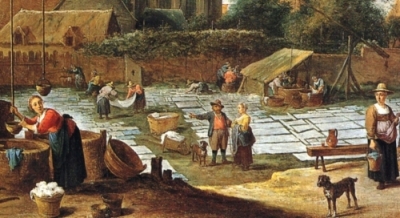 A drying area could be communal, shared by a whole village or neighbourhood; it
could be private ground by a large house, or owned by a cloth manufacturer. Domestic
bleaching could last just one day or go on for a few days. Before the 19th century
and the arrival of modern chemicals, it was sometimes done by professionals called
whitsters. Whitsters visited large, prosperous households at intervals to "spring-clean"
the linen. They might also work on their own premises.
A drying area could be communal, shared by a whole village or neighbourhood; it
could be private ground by a large house, or owned by a cloth manufacturer. Domestic
bleaching could last just one day or go on for a few days. Before the 19th century
and the arrival of modern chemicals, it was sometimes done by professionals called
whitsters. Whitsters visited large, prosperous households at intervals to "spring-clean"
the linen. They might also work on their own premises.
Household and personal linen was spread on the grass, soaked with buckets of
lye at intervals, and eventually rinsed and dried. There were variations,
like using plain water and no lye, and the process might last for three days.
Drying on a clothes line
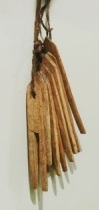
As well as using grass, you could spread laundry on hedges and bushes. Drying frames with wooden poles rather than ropes were another possibility. If you had poles, rope and pins/pegs you could have a clothes line. Until the 20th century clothes pins were quite simple pieces of wood: split twigs bound with wire or twine like these made by English Romanies, or very plainly-cut wood like the German ones in the photo (right).
In a recent episode of the BBC version of Cranford, a gypsy from the 1840s was selling suspiciously machine-smooth wooden pegs. Take a look at these English examples and this collection from an Austrian museum to get an idea of how simple a hand-made clothes peg could be.

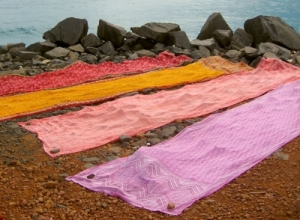
Picture below right: Stones hold saris flat while they're spread out to dry in Pondicherry, India.
 5 December 2007
 For more on old laundry methods see:
History of Laundry: washing and drying
Laundry from 1800
History of Ironing
or:
Great wash and washdays
Bluing white laundry
Washing bats and beetles
Ashes, lye and bucking
Washboards
Washing dollies


You may like our new sister site Home Things Past where you'll find articles about antiques, vintage kitchen stuff, crafts, and other things to do with home life in the past. There's space for comments and discussion too. Please do take a look and add your thoughts. (Comments don't appear instantly.)
For sources please refer to the books page, and/or the excerpts quoted on the pages of this website, and note that many links lead to museum sites. Feel free to ask if you're looking for a specific reference - feedback is always welcome anyway. Unfortunately, it's not possible to help you with queries about prices or valuation.