

-
History of:
- Resources about:
- More:
- Baby walkers
- Bakehouses
- Bed warmers
- Beer, ale mullers
- Besoms, broom-making
- Box, cabinet, and press beds
- Butter crocks, coolers
- Candle snuffers, tallow
- Clothes horses, airers
- Cooking on a peat fire
- Drying grounds
- Enamel cookware
- Fireplaces
- Irons for frills & ruffles
- Knitting sheaths, belts
- Laundry starch
- Log cabin beds
- Lye and chamber-lye
- Mangles
- Marseilles quilts
- Medieval beds
- Rag rugs
- Rushlights, dips & nips
- Straw mattresses
- Sugar cutters - nips & tongs
- Tablecloths
- Tinderboxes
- Washing bats and beetles
- Washing dollies
- List of all articles
Subscribe to RSS feed or get email updates.
I am a besom maker, listen to my tale,
I am a besom maker, lives in yonder vale
Sweet pleasures I enjoy both morning, night, and noon
Going over the hills so high a gathering of green broom.
Come buy my besoms, besoms fine and new,
Bonny green broom besoms, better never grew...
Traditional English song - printed copies survive from mid-19th century
Old English Household Life by Gertrude Jekyll, from Amazon.com
or Amazon UK

Among the broom-squarers or broom-squires there have always been some very rough characters....But there are many good, honest, hard-working men amongst them.
Gertrude Jekyll, Old West Surrey, 1904
Besoms & Brooms
Sweeping with birch, heather, and other twiggy shrubs
 When you stop and think about it, you probably
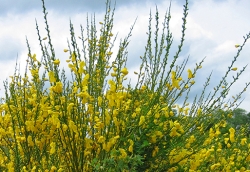
realise that brooms got their name because they used to be made of branches of broom, a yellow-flowering shrub
- except when they were made of birch or heather. Many other shrubby plants have
been used across the world for sweeping and brushing. Tie a bundle of good local
twigs together, with a tight, narrow grip at one end, and you can whisk dirt away.
If you attach the broom to a broomstick, so much the better.
When you stop and think about it, you probably
realise that brooms got their name because they used to be made of branches of broom, a yellow-flowering shrub
- except when they were made of birch or heather. Many other shrubby plants have
been used across the world for sweeping and brushing. Tie a bundle of good local
twigs together, with a tight, narrow grip at one end, and you can whisk dirt away.
If you attach the broom to a broomstick, so much the better.
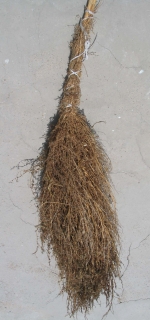
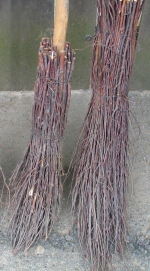 Besom is an even older name for these
cleaning tools than broom, though both names go back many centuries. Broom (cytisus
pictured bottom right) and other plants like heather (broom pictured right) and
furze that grew on open land were popular for besoms in parts of Britain, while
birch was a mainstay, especially in more wooded areas. Birch was used across Europe:
in
Switzerland, for example, and in Romania. (See picture left)
Besom is an even older name for these
cleaning tools than broom, though both names go back many centuries. Broom (cytisus
pictured bottom right) and other plants like heather (broom pictured right) and
furze that grew on open land were popular for besoms in parts of Britain, while
birch was a mainstay, especially in more wooded areas. Birch was used across Europe:
in
Switzerland, for example, and in Romania. (See picture left)
Birch brooms were popular in some industrialised countries, for some purposes, well into the 20th century. In England they were not only valued by rural people who wanted cheap brooms, but were also in demand for sweeping leaves off the lawns of stately homes, and for clearing waste away in steel mills.
In North America besoms died away relatively early. Around 1800 the corn broom started to take over: well-suited to a landscape with space to grow lots of broomcorn (sorghum). Not so in Britain. The UK's 19th century "new broom" was the bass-broom. Bass meant plant fibres of various kinds, especially palm fibres, imported from distant parts of the British Empire. The fibre "bristles" were inserted into the familiar shape of wooden brush head on wooden handle.
 Broom-making was generally thought
of as a man's job in Europe, often but certainly not always a Romany gypsy craft.
(Confirmed by this article on brooms
in south-eastern Europe - a must-read for anyone interested in plants used
for broom-making.) But England had some women in the trade, outside the main birch-broom
areas where male "broom squires" were predominant. Thomas Hardy's Return of the
Native includes a woman besom-maker, and so does a popular 19th century
bawdy song. (See excerpt in left-hand column)
Broom-making was generally thought
of as a man's job in Europe, often but certainly not always a Romany gypsy craft.
(Confirmed by this article on brooms
in south-eastern Europe - a must-read for anyone interested in plants used
for broom-making.) But England had some women in the trade, outside the main birch-broom
areas where male "broom squires" were predominant. Thomas Hardy's Return of the
Native includes a woman besom-maker, and so does a popular 19th century
bawdy song. (See excerpt in left-hand column)
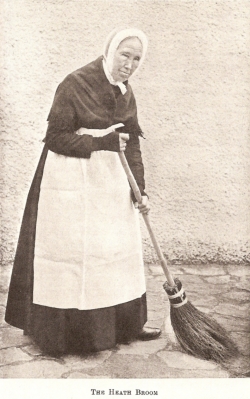
Gertrude Jekyll, the garden designer, bought "four dozen birch and two dozen heath" brooms a year, presumably for her staff. She paid three shillings and sixpence for a dozen birch brooms, and less for heath: half a crown a dozen. She also took an interest in how they were made. Just after 1900 she photographed the woman above, and described the traditional craft, as practised in southern England at that time:
The birch spray is not used fresh. It is put aside to dry and toughen for some months. Then they 'break birch for brooms'. A faggot is opened and the spray is broken by hand to the right size and laid in bundles. Breaking birch is often women's work. The 'bonds' that fasten the spray on to the handle are of hazel or withy, split and shaved with the knife into thick ribbons. They are soaked in water to make them lissom. There is usually a little pool of water near the broom-maker's shed, where the bonds are soaked.
The broom-squarer gathers up the spray round the end of the stick, sitting in front of a heavy fixed block to which the further end of a bond is made fast. He pushes the near end of the bond into the butts of the spray, nearly at a right angle to the binding. He then binds by rolling the broom away from him, pulling tight as it goes. When he has bound up to the length of the bond, the butt is released and pushed into the work. Heath brooms have two bonds; birch, which are much longer, have three. A hole is bored between the strands of spray and through the stick. The rough butts are then trimmed off, and the broom is complete.
Gertrude Jekyll, Old West Surrey, 1904
 The English Museum of Rural Life has a sequence of pictures showing
besom making in the 1940s.
The English Museum of Rural Life has a sequence of pictures showing
besom making in the 1940s.
 1 March 2008


You may like our new sister site Home Things Past where you'll find articles about antiques, vintage kitchen stuff, crafts, and other things to do with home life in the past. There's space for comments and discussion too. Please do take a look and add your thoughts. (Comments don't appear instantly.)
For sources please refer to the books page, and/or the excerpts quoted on the pages of this website, and note that many links lead to museum sites. Feel free to ask if you're looking for a specific reference - feedback is always welcome anyway. Unfortunately, it's not possible to help you with queries about prices or valuation.