
-
History of:
- Resources about:
- More:
- Baby walkers
- Bed warmers
- Besoms, broom-making
- Box, cabinet, and press beds
- Butter crocks, coolers
- Clothes horses, airers
- Cooking on a peat fire
- Drying grounds
- Fireplaces
- Irons for frills & ruffles
- Log cabin beds
- Lye and chamber-lye
- Marseilles quilts
- Medieval beds
- Pressure cookers
- Rag rugs
- Riverside washboards
- Rushlights, dips & nips
- Sugar cutters - nips & tongs
- Straw mattresses
- Washing bats and beetles
- Washing dollies
- Wet wash, bag wash
- List of all articles
Subscribe to RSS feed or get email updates.
...the dampened linen to be pressed was wrapped around the roller flat on a table and the roller was worked back and forth by means of the flat board, a downward pressure being exerted by the hand at the same time.
Edison Monthly, Jan 1922
Norwegian Touches: History, Recipes, Folk Arts Notably Norwegian by Louise Roalson, from Amazon.comor Amazon UK
![]()
Back to Basics: A Complete Guide to Traditional Skills by Abigail Gehring, from Amazon.comor Amazon UK
![]()
Everyday Life in Early America from Amazon.com
or Amazon UK![]()
Alison Sim, The Tudor Housewife, from Amazon.comor Amazon UK
![]()
Knitters in the Yorkshire Dales around 1850 used...
...a knitting-sheath consisting commonly of a hollow piece of wood, as large as the sheath of a dagger, curved to the side, and fixed in a belt called the cowband. The women of the north, in fact, often sport very curious knitting-sheaths. We have seen a wisp of straw tied up pretty tightly, into which they stick their needles; and sometimes a bunch of quills of at least half a hundred in number. These sheaths and cowbands are often presents from their lovers to the young women. Upon the band there is a hook, upon which the long end of the knitting is suspended that it may not dangle.
William Howitt, The Rural Life of England, 1854
The Art of Fair Isle Knitting: History, Technique, Color & Patterns by Ann Feitelson, from Amazon.comor Amazon UK
Knitting America: A Glorious Heritage from Warm Socks to High Art by Susan M. Strawn, from Amazon.comor Amazon UK
![]()
One 'pin' would be tucked into a 'shear' under her arm. These knitting sheaths were made of [cotton] print, small cases a few inches long, and filled tightly with quills - they held one needle, leaving a hand free for quicker movement with the wool. Sometimes a wisp of straw rolled tightly was used instead. Wooden knitting sheaths and sticks were also seen, and the sheaths were occasionally beautifully carved. They were used stuck into, or through the waistband ...
Gladys Thompson, Patterns for Guernseys, Jerseys, and Arans: Fishermen's Sweaters from the British Isles, 1979 edition, first published 1955
Folk Socks: The History and Techniques of Handknitted Footwear, by Nancy Bush, from Amazon.comor Amazon UK
![]()
![]()
Elizabeth Barber, Women's Work: The First 20,000 Years - Women, Cloth, and Society in Early Times, from Amazon.comor Amazon UK
![]()
![]()
Making Hand-Dipped Candles: Storey Country Wisdom
from Amazon.com![]()
or Amazon UK![]()
Old Cooking Utensils by David Eveleigh, from Amazon.comor Amazon UK
![]()
One 19th century Tennessee hanging chimney was constructed from wood and clay in the middle of the room.
The singular part of the house was its interior arrangements. It literally had a hanging chimney in the center of the room. By some means long beams were fastened to the joists and the rafters, extending a few feet above the roof and down to within four or five feet of the fireplace. These beams widened out from the roof toward the floor like a funnel. Across the beams laths were nailed. Then the chimney was stuccoed, not with lime plaster, but with red clay mud.
Oliver Perry Temple, Notable Men of Tennessee, 1912
...In wooden buildings...smoke hoods were either suspended from the ceiling rafters or supported by stone or brick pillars...In stone buildings...hearths were often moved to positions along the walls and placed under hoods attached to the walls.
Paul B Newman, Daily Life in the Middle Ages, 2001
Encyclopedia of Kitchen History by Mary Snodgrass
from Amazon.com
or Amazon UK
Black Sea German immigrants .. to the Northern Great Plains ... [had a] basic vernacular architecture... Some dwellings have a black kitchen (schwarze kuche), a small, centrally located, six-foot-square room that functions as a separate space for preparing and cooking food. Abutting the black kitchen and heating the parlor and rear bedroom is a large clay oven...
Michael H Koop of the Minnesota Historical Society in David J Wishart's Encyclopedia of the Great Plains, 2004
From Catharine Beecher to Martha Stewart: A Cultural History of Domestic Advice from Amazon.com
or Amazon UK![]()
Whatever its form or name, and both were subject to regional variation, the dolly was generally operated as a Cumberland author ... described it: "The dolly is plunged into the mass and worked by the dollier with both arms, with a curious lateral motion to left and right alternately..."
Patricia E. Malcolmson, English Laundresses: A Social History, 1850-1930, 1986
Patricia E. Malcolmson, English Laundresses: A Social History, 1850-1930 from Amazon.com
or Amazon UK![]()
Pamela Sambrook, Laundry Bygones,
from Amazon.com or Amazon UK![]()
The Country House Servant from Amazon.com
or Amazon.UK
Antique household equipment, furnishings, utensils
- housekeeping as part of social history. Domestic life, household management -
how people organised their homes and did the daily chores. Yesterday's everyday
objects are today's antiques or museum pieces, and we may view them with nostalgia
or curiosity about past ways of life. Old & Interesting takes a look at how
these everyday things were actually used, how people managed their home life - and
more. Alongside articles illustrated by excerpts from advice manuals, period novels
and other literature, this page is updated every couple of weeks. RSS
feed or
email will let you know about new articles.
Mangle boards
Mangling board and pin, board and roller - carved or plain
Hot metal pressing irons are so common that we may forget how widespread wooden
mangling boards once were. People who have heard of mangle boards may know they
were traditional courtship gifts carved by young men in Scandinavia or the Netherlands.
They were found further afield too, and were a standard way of smoothing linen from
Russia to France, from Iceland to Bosnia. We know they were in use before 1600 and
in some places were still familiar in the 20th century.
How
do they work? Like the 100-year-old Norwegian tools in the photograph, the board
was always one half of a pair. A roller was an essential companion to the board.
While the board could be beautifully decorated on one side - sometimes with carved
initials and dates - the roller had to be smooth and plain for effective "ironing".
Two utensils are necessary - the first a kind of rolling-pin, round which the sprinkled linen is tightly swathed. The other, a mangling-board, a narrow flat piece of wood ... is then pressed tightly on the linen and rolled with as much force as possible.
Nico and Beatrix Jungman, Norway, 1905
Click through to pictures from
Germany and
Estonia that show how the board was placed at right angles to the roller.
Skill and experience would make for a good rolling action, balancing heavy pressing
with smooth motion. Experience would help you know how damp the cloth should be,
how best to wind it etc. In some regions, a handle on top of the board helped you
press down firmly.
Animal-shaped
handles like the horse were often favoured in Norway and Sweden, while the English
board from Whitby, Yorkshire pictured above left has a lion handle. In parts of
northern England these mangling tools were called a 'bittle and pin'. Attractive
carved boards could help decorate the home, as in this
picture from Marken, Holland
The oldest dated mangle board is from 1566, and is kept in the Arnhem museum, according to the Musée des civilisations de l’Europe et de la Méditerranée.
During the sixteenth century the mangling board and roller came into general use. The idea spread from Holland, Denmark and northern Germany.... The material was wrapped round the roller...which was placed on a flat table. The mangling board [was] then passed backwards and forwards over the roller until the fabric was smoothed.....The idea was exported by Dutch colonists, particularly to North America and South Africa.
Ian McNeil, Encyclopedia of the History of Technology, 1990
The pictures on this page are not to scale, and some come from books published in
the early 20th century by authors who didn't record sizes, even though they were
experts in their subjects. (Like Charles Holme's books on 'Peasant Art'.) However,
we know the Norwegian board top right is about 70cm or 27 inches long. This is not
untypical for mangle boards from Scandinavia. Edward Pinto, author of
Treen and Other Wooden Bygones,
thought these were some of the heaviest boards because wood was abundant there,
and reports that boards from Friesland (northern Netherlands) were much lighter.
Ages are also not mentioned though some have dates from the 1700s or 1800s carved
into them.
These batlers or battledores, as they are now generally called, are still in use in Yorkshire. They are the prototype of the "patent mangle", and consist merely of a flat rectangular piece of wood, some two feet long, and six inches broad, with a thin short handle. The linen to be mangled is coiled round a roller, which is placed on a table, and then the batler is placed on the top, and pushed forwards and backwards on the roll under pressure of the hands. They were not used in Yorkshire only. I procured a very handsome specimen in Suffolk some years ago, the upper surface of which is rather elaborately carved with a Gothic design. The initials of the owner are burnt in in Gothic letters-, and the article cannot have been made more lately than the beginning of the sixteenth century.
Notes and Queries, 1865
The mangle boards in the last
two pictures, with fine chip carving, come from Holmes' books, Peasant Art in Sweden,
Lapland, and Iceland, and Peasant Art in Austria and Hungary, which includes areas
of the old Austro-Hungarian empire like Transylvania, a Hungarian-speaking culture
within modern Romania. Some are quite similar in shape to
laundry bats. In parts of England mangling and washing boards/bats had similar
regional names.
The concept of pressing linen with a weight and rollers was developed into the large box mangle - illustrated and explained on the box mangle page.
8 Jan 2010
Knitting Sheaths & Belts
Helping the busy knitter
Why
discuss knitting tools on a website about housekeeping, chores, and traditional
"women's work"? Today we see hand-knitting as a hobby, a creative craft practised
in our leisure time, but it used to be an ongoing task, to be fitted in amongst
all the other chores. Families had to be kept supplied with socks, hats, and warm
clothing. Some households stretched their income by making items for sale as well.
Many women (and in some places, men) had to work at it every day - except perhaps the Sabbath. And they couldn't always have the luxury of sitting down to knit. They knitted while walking to market, or fetching home fuel (like the peat-carrying woman right), and at many other moments in their busy lives.
A
knitting sheath or knitting belt made the job faster and easier, especially for
anyone knitting on the move. Put the end of one knitting needle into a holder, which
is fixed at the waist. Now the right needle is kept in position by the sheath, and
the knitter's right hand is freed up to manipulate the yarn more smoothly. (This
requires needles pointed at both ends - see this
video or photo.)
One-handed knitting is not impossible.
Knitting sheaths were familiar in many European countries and in North America, while the knitting belt with pad (see below) seems to have belonged mostly to northern England and Scotland. Use of knitting sheaths declined during the 19th century as industrial machine knitting increased. However, in some areas of the UK, like Yorkshire and Shetland, commercial hand-knitting continued, using traditional sheaths and belts.
Wooden knitting sheaths are quite well-remembered today - perhaps because the well-crafted and/or personalised ones were handed down within families. Some were made by young men as love gifts, and have carved initials, mottoes, or dates. In fact, wooden sheaths were by no means the only kind. (Skip directly to quill and cloth sheaths for more on these half-forgotten but once common knitting aids.)
Wooden knitting sheaths, sticks, or cases
At their simplest, these were just a hollowed-out stick. More elaborate carved sheaths
go back to at least
the 17th century. There has been a revival of interest recently in these,
and some craftsmen are making them for sale. "Goosewing"
types have a curved lower half to fit at the waist. Some had grooves to fit a belt.
The longer types are more likely than others to be called knitting sticks, but names
were regional, and there is no consistent rule about this. Knitting case was another
name.
Knitting belt with pad or pouch
Instead of tucking a rigid sheath into
a waistband, you can use a belt with leather pouch attached. Stuffed with horsehair
and covered with holes where you slot in the needle, this kind of knitting belt
is best known in Shetland where it may be called a makkin (making) or maakin belt.
Children in Shetland schools today are shown how to use one.
It was also a traditional tool in other parts of the northern UK: in NE Scotland, for instance. See this knitting belt with needles in position.
When I first remember Filey...[1910, 1920?]...knitting tippies, like those seen in Shetland were worn, these were small leather pouches...one...was pierced with several holes, into one of which the pin was stuck, and held round the waist by a leather band. The Flamborough tippie was a flap of leather pierced by two holes, through which a strong 'bit of band' was threaded and twisted round the long knitting needle...
Gladys Thompson, Patterns for Guernseys, Jerseys, and Arans: Fishermen's Sweaters from the British Isles, 1979 edition, first published 1955
Sheaths made from quills, leather, straw, metal, bone, with or without cloth covers
A common kind of knitting sheath, not often mentioned today, was a goose quill sewn into fabric. They originated in Europe, and seem to have been used in many parts of North America. A goose feather was trimmed to make a tube to hold the needle, and stitched into a cloth holder. This was pinned to the knitter's clothing.
...she may have an ivory knitting-sheath in which the needle is placed. Otherwise she takes two pieces of woolen cloth and sews a narrow slip, large enough to admit a goose quill, and this is pinned to her side...
Mason A. Green, Springfield [Mass.] Memories, 1876
..a knitting sheath was made with a goose quill and a piece of holland linen...
R. P. Hopper, Old-Time Primitive Methodism in Canada, 1829-1884
Knittin-sheth... A quill sewed in a piece of calico or cloth and pinned to the front of the dress to rest the end of one needle in while knitting.
Bennett Wood Green, Word-Book of Virginia Folk-Speech, 1899
"...she said she had to have a knitting quill and they had long since quit using them so mama made her one. ... It was made of a piece of brown jeans cloth. ... There was a piece of goose quill sewed in the center and you pinned the cloth to your lap and stuck one needle in the quill."
Memoirs of Tennessee c1890
Other simple kinds
A tightly tied bunch of straw could serve as a knitting sheath. A bundle of seabird quills was an alternative in coastal areas. This straw 'wisp' was still being used for Fair Isle knitting in the 1920s, though most Shetlanders had gone over to leather knitting belts by 1900. Wisps of straw lent their name to other knitting sheaths and belts called whisks, whiskers etc. A rolled piece of leather was sometimes used, and there were plenty of steel, tin or bone tubes. These could be sewn into a cloth holder.
Abby's parcel contained a new steel knitting sheath, a set of needles, and a large ball of fine yarn.
Story for Christmas Eve, from Sunshine in the Heart - A Book for Girls, 1860
Decorative sheaths
Some of the fancier sheaths were tucked in at the waist, but many came with loops for a ribbon to pin on to clothes, or were even made like a brooch with a jeweller's pin. Some may not have been tough enough for big, heavy pieces of knitting. Others were as good as the more workaday kinds.
- French or Italian fine carving
- Decorative silver knitting heart and fish from the Winterthur Museum
- Dutch silver knitting sheaths
- Portuguese sheath - lead on carved wood
...her gold knitting needles and the gold knitting sheath mounted on black velvet which she wore in the evenings had been given by my father or my grandfather...
Memories of 1826, in Salt Lake City Sunday Herald, 1892
Fabric covers
Related tools
Knitting sheaths were often used with yarn holders that were also attached to the
clothing or tied on with belts etc. These hooks, bags, or baskets were called clew-baskets,
clew-hooks etc. in northern England. (Clew, or clue, is a very old word for a ball
of thread.) There might also be a hook to hold up larger pieces of knitting and
save them from dragging.
27 Nov 2009
Hanging chimneys and smoke canopies
Hinging lum - one way of getting smoke out of the home
A hole in the roof is a rough and ready
way of ventilating a small home with a central fire. Smoke will linger in the room.
Everything will be smelly and dirty. Sweeping and scrubbing will make only a brief
impact, and clean laundry will not stay fresh for long.
How can you funnel smoke away without sophisticated architecture like angled chimneys and fireplaces recessed into the wall? One solution tried by medieval builders was a kind of canopy or "hanging chimney" placed over an open stone hearth, guiding fumes towards a roof outlet, directly or with a simple flue. Archaeological evidence is scarce, since simple hearth hoods built of wood and clay hundreds of years ago don't leave obvious remains.
However, in the Scottish Highlands and Islands "hanging" hearth canopies, or hingin
lums (hanging chimneys) continued into the 20th century. The one photographed
was still in use about 1950. The gaps between the wooden laths here are stuffed
and covered with paper, rather than clay. A photograph from the 1930s displayed
in a longhouse at Moirlanich, Perthshire shows the lum covered in floral
wallpaper while a woman sitting nearby stirs porridge over a
peat fire. The house has not been restored, just conserved as it was when
acquired by the National Trust for Scotland,
so perhaps the plain white paper dates from the 1940s?
Hingin lums used the wall for support. Along with a hearth at the side of the (stone-walled) room, they were common in Scotland and Ireland until the 20th century. In the second photograph you can see a piece of iron used as a fireback, along with all the other fireside paraphernalia: wood stored under seat, bannock spade on wall, kettle hanging from a "swee" chain.
Fogolar
If you keep an open hearth in the middle of the room you may use a smoke funnel
like the ones that hang over the traditional fogolar of northern Italy: a
raised stone platform-hearth in the middle of kitchen/living-room. Overhead is a
round or square masonry hood. It can be plastered, panelled, and trimmed in various
ways, while underneath is simple brick or stonework. These are now very desirable
"features" in restored farmhouses etc. but the earliest ones are not attached to
carefully-designed chimneys, and are more likely to be ventilated by simple flues.
The 1930s photo of a big Italian kitchen (right) shows quite an elaborate version, with raised, shaped cooking area, and a hood with wooden trim. A simpler, lower square hearth is more typical, while hood shapes vary regionally from four-cornered to rounded onion or bell styles. Sometimes the fogolar is at the side of the room with a canopy supported by the wall, as with the Scottish hingin lum.
The wrought iron "double wing" frame, called cjavedâl in Friuli, is an important part of the set-up, with hooks and chains for cooking pots. Look at Il Fogolâr for a picture of a traditional onion-shaped plaster finished canopy over a simple square hearth on a page with fogolar-related vocabulary for those interested. (Run it through Google's 'language tools' for an English version.) There are more pictures in this book on fireplaces, and this page on fogolar cooking tools.
Smoke attics, black kitchens, smoke bays, and other pre-modern approaches to smoke
Taking smoke away from living areas was an important development in home life, with
many implications. (Imagine your kitchen or sitting room filled with smoke.) There
were various ways of cleaning things up in the transition between a simple hole
in the roof and a fireplace set back into a wall with a carefully angled built-in
chimney. For example, you could channel fumes to the roof through a smoke bay or
smoke hood constructed in between rooms on the upper storey of a house. The
house diagrams here from 16th century southern England illustrate this clearly.
Similar arrangements could lead fumes to an attic used for smoking foodstuffs.
The "black kitchen" or "smoke kitchen" in the photo (left) was the way many central
European houses kept smoke out of the living areas. Cooking was done over an open
fire with no chimney, but the kitchen was separated from the rest of the house.
To the right is a medieval picture of a hearth with canopy from an edition of the Tacuinum Sanitatis published in 14th century Lombardy, Italy.
See also: pages on related kitchen or fire topics:
Peat or turf fires
Bakers' paddles or peels
Bannocks cooked on open hearths
Fireplaces
3 November 2009
Ponch, punch or ?
Ponches, possers, plungers, stompers, dollies - naming old laundry tools
OldandInteresting has mentioned
before that it's difficult to get a detailed picture of regional differences in
the names for simple domestic items - let alone differences from one English-speaking
country to another. The butter pats/Scotch hands
names are just one example.
Untangling the variety of words is complicated when it comes to historic laundry items. Washing and other laundry tasks were often done by people near the bottom of the social ladder. Their work and vocabulary didn't attract much interest from writers - far less from dictionary-makers. Sometimes we get pre-1800 clues from descriptions of textile manufacture. After 1800 there were plenty of household advice manuals but these books weren't generally about the way laundry was really done by self-employed washerwomen and working class housewives, and often focussed on how to run more prosperous households.
The names dolly, posser, ponch, punch, stomp, beater, plunger, pounder, and dasher have become blurred over time and are sometimes used interchangeably....
There is a basic difference between the dolly and the dasher. The dolly is used to pound the clothes and ..may [also] be used to grab onto and move the clothes through the water. The dasher, in addition to pounding, forces water through the clothes, especially on the downward stroke.
Lee M Maxwell, Save Womens Lives: History of Washing Machines, 2003
We can understand why you
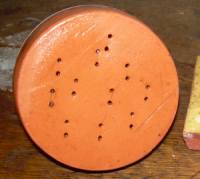
would call the laundry tool in the first photo a laundry ponch or punch. It was
used for punching down on washing in a tub, squeezing and forcing out dirt. In some
places ponch was certainly its name. Yet there were areas of the UK where this kind
of tool was called a posser, or even a washing dolly,
dasher, stomper etc. Many were used
by women standing over a tub placed on the floor. Some had short handles for
use in a sink . In the UK posser often suggests a metal cone on a handle
manufactured in the 19th or 20th century, like the one pictured left. In the US
this is almost always called a plunger.
Using a dolly peg is a strenuous task, requiring both a rotational and a vertical movement. The washing punch was used to similar effect but with less of a rotational action. Possers were used with a vigorous vertical movement...
Pamela Sambrook, Laundry Bygones, 1983
This page quotes some modern writers who've touched on the topic of names for this kind of tool. Meanwhile, the older washing bat, beetle or battledore used for laundry has its own naming issues. This interesting blog with a picture of a wonderful 17th century carved laundry bat tells how the curator of colonial American reproductions at Plimoth in Massachusetts settled on 'battledore' as the name for their squarish washing bats. She was up against the usual problem of finding no consistent, tidy distinction between battledores and beetles, batting-staffs and bats, that held good from region to region. Though she found that battledore was certainly used to describe a flat, square shape, we must assume it could also refer to a long, thin cylindrical shape, since there is a 1655 recipe calling for a battledore to be used like a rolling pin. (Gumbals or jumbals recipe in the Queen's Closet Opened by Hannah Wolley.)
[In the early 1900s]... a 'dolly'... was a four- or five-legged stool attached to an upright handle across which there was a crossbar handle. In Birmingham the stool was replaced by a block of wood, indented at intervals, which was properly called a laundry punch; in the North-East it was replaced by a perforated copper cone known locally as a 'possing stick'.
Carl Chinn, They Worked All Their Lives: Women of the Urban Poor, 1880-1939, 1988
For more on on old laundry methods see:
Lye and chamber lye
Wash days and bucking
Laundry blue
Washing dollies, plungers, possers
See also:
History of ironing
25 July 2009
For sources please refer to the books page, and/or the excerpts quoted on the pages of this website, and note that many links lead to museum sites. Feel free to ask if you're looking for a specific reference - feedback is always welcome anyway. Unfortunately, it's not possible to help you with queries about prices or valuation.

"